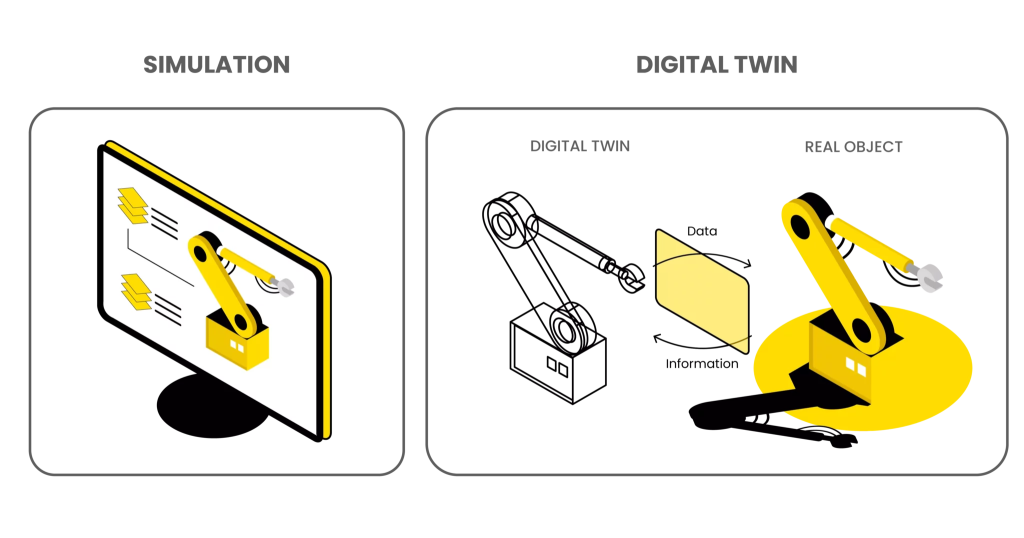
The confusion between ‘Simulation’ and ‘Digital Twin’ often leads businesses to implement one technology while mistakenly believing they possess the other — or worse, to regard them as interchangeable.
In reality, these two technologies represent entirely different approaches to modeling and understanding the physical world. In this article, we will decode the nature, technical requirements, and true business value that each technology offers.
1. What are Simulations?
Simulations are predictive models designed to forecast outcomes under specific conditions and constraints. Instead of merely analyzing data, simulations create controlled virtual environments where variables can be altered to observe their impact.
Core Characteristics:
- Scenario-Based: Addresses the ‘What if?’ question, enabling hypothesis testing without real-world risk.
- Time-Bounded: Captures ‘snapshots’ of possible futures rather than reflecting a continuous state.
- Hypothesis-Driven: Utilizes algorithms and statistical frameworks to generate probability distributions instead of a single outcome.
Practical Applications & Limitations: Simulations excel at risk assessment, strategic planning, and performance forecasting. However, they have significant limitations: static data inputs, inability to incorporate new real-world data after execution, scenarios limited by predefined variables, and computational capacity barriers as complexity increases.
2. What is a Digital Twin?
Unlike simulations, Digital Twins create a persistent, two-way connection between physical assets and their digital representations. They are ‘living mirrors’ that reflect not only the present but also the historical and predicted future states of a system. A true Digital Twin must possess 3 characteristics:
- Existence and Evolution: Continuously develops throughout the lifecycle of the physical asset.
- Two-Way Connection: Receives data from the real world and can send commands or adjustments back.
- Continuous Updates: Synchronizes in real-time with the physical world.
To build a Digital Twin, the system requires IoT (Internet of Things) connectivity, minimal latency data processing capabilities, and spatial anchoring to accurately link virtual data to its real-world location.
Unique Value: Digital Twins excel in operational management, performance discovery, and predictive maintenance. Unlike simulations, they possess the ability to automatically adjust behavior (adaptive response) based on changing conditions without human intervention, while also storing a complete history of operations for in-depth analysis.
3. Core Technical Differences
The differences between the two technologies stem from their data and system structures:
- Data: Simulations use static datasets at a single point in time; Digital Twins require continuous two-way data streams via sensors and robust network infrastructure.
- Processing Architecture: Simulations use batch processing models for complex calculations; Digital Twins utilize real-time architecture and distributed computing for instant responses.
- Storage: Simulations use scenario-based databases; Digital Twins use time-series databases to track historical and current states.
- Interaction Model: Simulation outputs are typically reports and graphs. Digital Twins offer interactive dashboards and spatial augmented reality (AR) interfaces for operators.
4. How Does Spatial Computing Elevate Both Technologies?
The rise of Spatial Computing — combining location data, 3D models, and immersive interfaces — has amplified the power of both technologies. It helps systems understand the location of objects and their interactions in 3D space through Visual Positioning Systems (VPS) and Spatial Mapping.
- For Simulations: Makes environments more vivid (via VR/AR), accurately models physical barriers (such as viewpoints, human movement), bringing unprecedented levels of accuracy.
- For Digital Twins: Transforms the system into an intuitive interface. Users can employ AR (like ‘X-ray vision’) to view operational data overlaid directly onto physical machinery, track assets with millimeter-level precision, and optimize workflows.
5. Return on Investment (ROI) and 5 Pitfalls to Avoid
The financial models of these two technologies are entirely different. Simulations provide ‘episodic’ benefits by preventing risks or avoiding erroneous prototype development. In contrast, Digital Twins generate a continuous, cumulative value chain by optimizing performance, extending equipment lifespan, and reducing downtime.
5 Common Pitfalls in Implementation:
- The ‘Upgraded Simulation’ Misconception: Believing that a Digital Twin is merely an advanced simulation and neglecting to build real-time data streams.
- The ‘Either/Or’ Mindset: In reality, simulations are used for the planning phase, while Digital Twins are for operational optimization. Leading organizations utilize both.
- Prioritizing Technology Over Business Problems: Leading to misalignment and difficulty in application.
- Lack of Data Foundation: Neglecting investment in IoT and network infrastructure for Digital Twins.
- Misunderstanding Scalability: Simulations require powerful computational resources, whereas Digital Twins need edge computing and deep IT/OT integration capabilities.
Conclusion: When Simulation and Digital Twin Converge
These are not two competing technologies. The most innovative organizations are combining them. Simulations provide a perfect foundation for determining sensor placement and building Digital Twins. Conversely, real-world data from Digital Twins helps calibrate and make future Simulations absolutely precise. Running ‘What-if’ simulations directly on the state of a Digital Twin is opening up an incredibly intuitive and intelligent decision-making environment.